Backcountry camping in Death Valley is not a matter of pulling off wherever a view looks inviting. The National Park Service distinguishes between roadside camping, backpacking, areas where camping is prohibited, and locations that require advance permits. The useful first decision is therefore not which spot looks best on a map, but whether the planned route and camping area fit the current rules.
Start by checking the road and the one-mile threshold
The park’s backcountry camping guidance allows roadside camping along dirt roads at least one mile beyond the junction with a paved road or a dirt road designated for day use. That distance is a minimum, not permission to camp anywhere along the road: the location must also be open to camping, and the park’s Backcountry and Wilderness Access Map is the reference for checking boundaries and restrictions.
Camping is prohibited along paved roads, in pullouts and parking lots, and in multiple named areas and roads. The National Park Service lists examples including the valley floor from Ashford Mill to two miles north of Stovepipe Wells, Eureka Dunes, Greenwater Canyon, and several day-use roads. Some other routes have restricted segments; Cottonwood Canyon Road, for example, is listed as closed to camping for its first eight miles. A route name alone does not establish that every part of it is available for overnight use.
Separate permit routes from other backcountry trips
Some roadside destinations have mandatory permits. The park’s published guidance identifies four-wheel-drive roadside camping along Echo Canyon, Hole in the Wall, and Cottonwood/Marble Canyons, as well as roadside camping in Greenwater Valley, as permit-required categories. The page describes online reservations up to six months ahead for those locations. Backpacking the Cottonwood–Marble Loop is also included as a mandatory-permit activity.
Other roadside camping, backcountry cabins, backpacking, and canyoneering are described as recommended-permit activities on that page. The distinction matters for planning: do not assume that a general backcountry trip is either permit-free or subject to the same reservation process as a named route. Review the current National Park Service page at nps.gov/deva/planyourvisit/backcamp.htm and the access map for the exact activity and location. Permit procedures and fees can change, so use the current official instructions before committing to dates.
Choose a site that limits damage, not just driving time
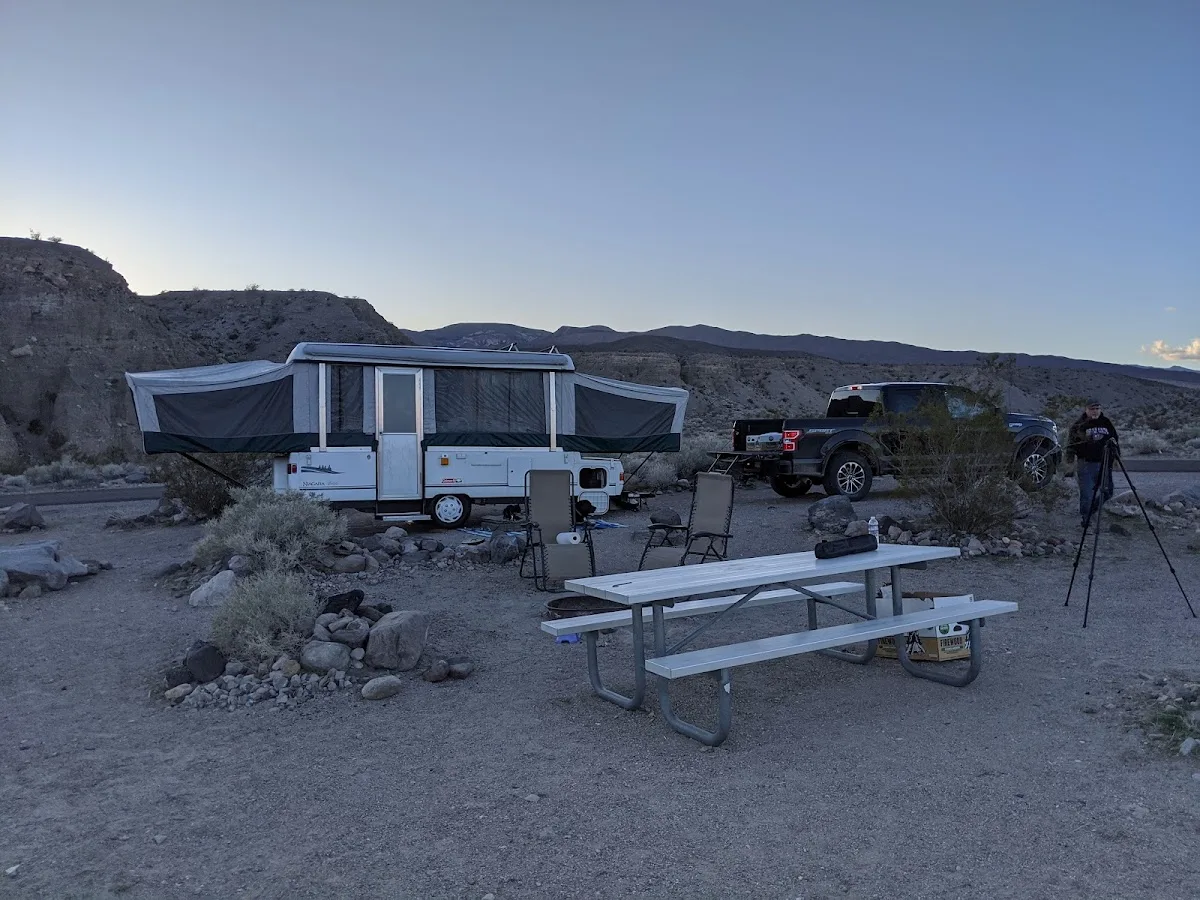
Death Valley’s desert surfaces recover slowly from vehicle disturbance. The park instructs campers to use previously disturbed areas and park immediately adjacent to the roadway rather than creating a new track. Off-road driving is prohibited. Those directions make site selection an impact decision as well as a navigation decision: a broad-looking patch of open ground is not automatically an appropriate place to drive or camp.
The NPS guidance also says campsites must be more than 100 yards from a water source to protect wildlife use. Group size is limited to 12 people and no more than four vehicles; larger groups must split up and camp at least half a mile apart. These limits can change how a group organizes vehicles and sleeping arrangements, so the full current rules should be checked before departure rather than interpreted from a map pin.
Plan water, fire, and pets around the actual rules
Water is a rare resource in the park, and backcountry campsites are not presented as serviced campground sites. Campers should carry what their itinerary requires and avoid relying on an assumed water supply at a dispersed location. The park’s guidance permits campstoves and propane grills, but prohibits gathering wood; fires are allowed only in provided metal fire rings at campgrounds or in firepans in the backcountry, and ash must be packed out.
Pet plans need the same careful reading. The NPS page says pets are permitted only in developed areas and on park roads, must remain leashed, and are not allowed off roads, on trails, or in wilderness. Someone planning to hike away from a roadside camp with a dog should not treat roadside permission as trail access. Confirm the current rule and make a care plan that does not depend on bringing a pet into prohibited areas.
Use listing details as identifiers, not trip guarantees
The place record identifies this entry as Death Valley National Park’s backcountry, gives the location as Death Valley, CA, United States, and lists +1 760-786-2146. It also shows a 4.6 rating from 10 reviewers. Those listing details can help identify the destination, but a rating is not evidence of road conditions, campsite availability, facilities, or permit status. For park rules, the NPS backcountry page and access map are more useful than a general listing.
Before setting out, match the intended route to the map, identify any mandatory permit requirement, check current park alerts and road conditions, and carry a backup plan if access or the chosen location does not work. That sequence keeps a remote camping trip grounded in the rules that actually apply to the selected road and site.